El sardinero, localización

Icono Español. Icon Spanish Las dos playas de El Sardinero están situadas en la ciudad de Santander. Ambas playas reciben el mismo nombre y se las conoce como: Primera Playa del Sardinero y Segunda Playa del Sardinero. Se accede a El Sardinero por múltiples vías una vez situados en Santander. Se puede llegar a Santander desde cualquier punto de la geografía española, compartiendo todos los trayectos cuatro localizaciones que pueden ser de partida o de transito. Estas son : Oviedo, Palencia, Bilbao y Burgos. Las tres primeros por autovía y la último por carretera nacional; atravesando el Puerto del Escudo. Ya emplazados en Santander o cercanías, hay dos opciones. Desde el oeste utilizando la S-20, llamada la Autovía del Sardinero. La otra opción es por medio de la S-10, atravesando la ciudad; pues la configuración de Santander se orienta hacia sus playas.

Nota: el trayecto por la S-20 ha sido selecionado con origen en el Barrio de La Albericia, para poder poder visualizar la autovía. Se puede partir desde cualquier otro punto que conduzca a la S-20.

El Sardinero, Localization

Icono Inglés. Icon English The two beaches of «El Sardinero» are located in the city of Santander. Both places are given the same name and are known as: First Sardinero Beach and Second Sardinero Beach. El Sardinero is accessed by multiple pathways once you have been located in Santander. You can reach Santander from any point of the Spanish geography. All the journeys share one of four possible locations that may be of heading or transit. These are: Oviedo, Palencia, Bilbao and Burgos. The first three by motorway and the last by national road; going through the port of «El Escudo«. When you already are in Santander or vicinity you can choose between two options. From the west using the S-20, called the Highway of «El Sardinero». The other option is through the S-10, which passes through the city. The configuration of Santander is oriented toward its beaches.

Note: the journey by the S-20 has been selected with origin in the district of La Albericia, in order to be able to display the dual carriageway. You can travel from any other point that is conected to the S-20.

Icono Español-Inglés. Icon Spanish-English Localización/Localization

Oviedo, El Sardinero: LocalizationPalencia, El Sardinero: LocalizationSantander, El Sardinero; S-10 : LocalizationBilbao, El Sardinero : Localization

Icon close Sponsor

Share

Segunda Playa del Sardinero, acceso

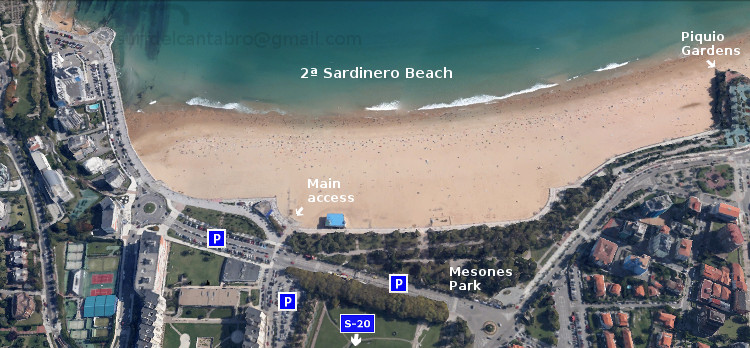
Icono Español. Icon Spanish. Segunda Playa del Sardinero. La Segunda Playa del Sardinero tiene varios accesos. Está rodeada por el Parque de Mesones y desde el parque se puede acceder a la playa por multitud de puntos. La entrada principal se localiza cerca del final del Parque de Mesones. Más a la izquierda, se encuentra ya el final del paseo y a la derecha de la playa, los Jardines de Piquío. Desde estos dos lugares se dispone de sendos accesos.

Second Sardinero Beach, access

Icono Inglés. Icon English. Second Sardinero Beach. The Second Sardinero Beach has several access. The beach is surrounded by the Mesones Park and from the park you can access to the beach by different points. The main entrance is located near the end of the Mesones Park. The left side is the end of the avenue and on the right hand of the beach, there are the Piquío Gardens. From these places are available another two accesses.

Icono Español-Inglés. Icon Spanish-English. Segunda Playa del Sardinero. Second Sardinero Beach. Acceso/Beach Access

Acceso: Segunda playa del Sardinero. Access: Second Sardinero Beach

Share

Primera Playa del Sardinero, acceso

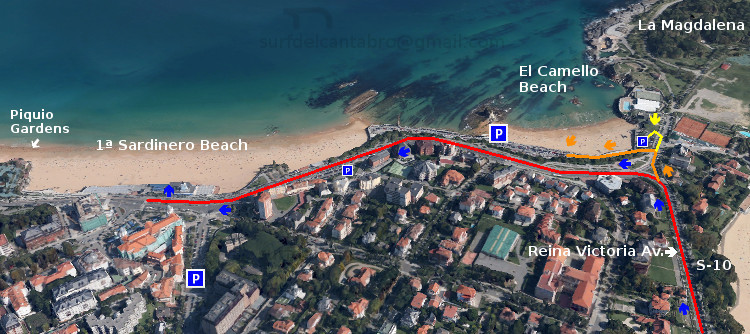
Icono Español. Icon Spanish. Primera Playa del Sardinero. La Primera Playa del Sardinero tiene múltiples accesos pues un paseo ajardinado la flanquea. Los tres principales accesos son los que se comentan a continuación. Desde el parking de la playa del Camello, se accede directamente a la parte derecha de la playa. Desde la Plaza de Italia, donde se localizan la mayor parte de restaurantes, atravesando los bajos del Sardinero; se llega directamente al centro de la playa. Desde los Jardines de Piquío, bajando las escaleras se accede a la parte izquierda de la Primera Playa del Sardinero.

First Sardinero Beach, access

Icono Inglés. Icon English. First Sardinero Beach The First Sardinero Beach has multiple accesses through the garden that flanks the beach. The three main accesses are discussed below. From the parking area of «El Camello» beach, you can directly access the right side of the beach. From the Plaza of Italy, where are located most of the restaurants, going through Sardinero main access; you will arrive to the center of the beach. From the Piquío Gardens, down the stairs is accessed to the left side of the First Sardinero Beach.

Icono Español-Inglés. Icon Spanish-English. Primera Playa del Sardinero. First Sardinero Beach Acceso/Beach Access

Acceso: Primera Playa del Sardinero, acceso. First Sardinero Beach, access

Icon close Sponsor

Share

Playa de Galizano: surf, submarinismo, pesca, senderismo …

Icono Español. Icon Spanish Galizano es una localidad costera cántabra que pertenece al municipio de Ribamontán al Mar. Desde Galizano se accede a sus playas y acantilados.

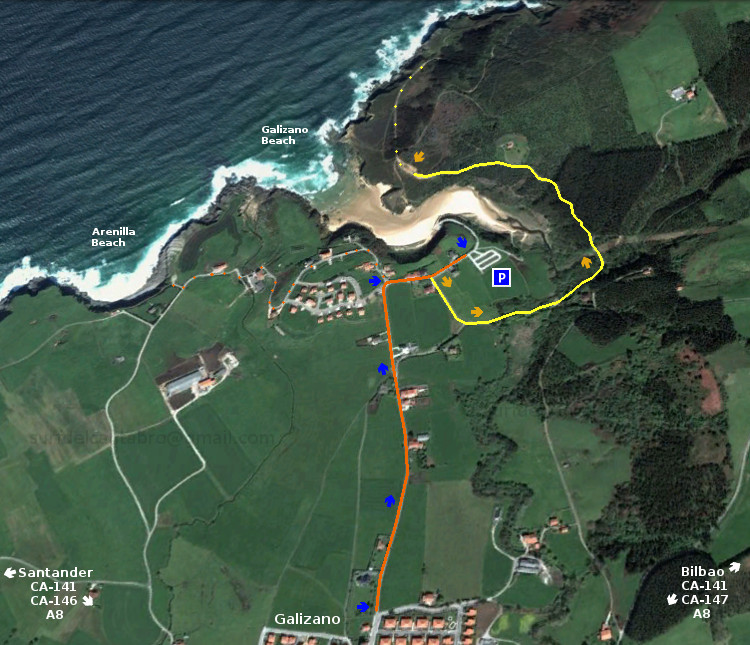
La playa de Arenilla es una pequeña cala de apenas 150 metros de longitud, que desaparece prácticamente en marea alta y es accesible en marea baja. Situada a la izquierda en el mapa; es apta para el baño e ideal para hacer submarinismo los días con la mar en calma. Se puede llegar hasta Langre realizando una ruta de senderísmo que conecta ambas playas. Es una zona muy buena para la pesca a surfcasting, teniendo en cuenta que esta situada en mar abierto y tomando las debidas precauciones.

La playa de Galizano tiene una configuración en forma de embudo que hace que su longitud varíe. Su arenal ocupa aproximadamente 400 metros de profundidad y es accesible siempre. El surf aquí es en crudo, salvaje, sin aditivos y con toda la potencia que impregna la naturaleza. Es necesario tener cierta pericia y nivel avanzado para practicarlo. Las olas nacen a 200 metros de la playa, siendo esta localización la ideal para hacer surf. Alejado así de las rocas se encuentra uno suspendido en el agua y esperando las olas vírgenes que trae el Mar Cantábrico. Pues no hay nada entre el mar y la Playa de Galizano que filtre el oleaje. Esto también lo convierte en una zona muy buena para la pesca recreativa a surfcasting.

Los días de temporal o fuerte oleaje prohíben la practica de cualquier actividad al aire libre que suponga la cercanía del mar. Sin embargo es en esos días cuando más se puede disfrutar de los acantilados de Galizano. Se accede a los acantilados dirigiendonos a la derecha de la playa, por una carretera que se sitúa antes de su acceso. Disfrutando del paseo, si se avanza en el camino se llega al mirador de la Cueva de «Cucabrera».

Galizano beach: surfing, scuba diving, fishing, hiking …

Icono Inglés. Icon English Galizano is a Cantabrian coastal town that belongs to the municipality of Ribamontán al Mar. From the locality is accessed to its beaches and cliffs.

The Arenilla beach is a small cove of barely 150 meters in length, that practically disappears during high tide and is accessible at low tide. Located on the left hand side in the map. It is suitable for swimming and ideal for diving the day with calm sea. You can arrive to Langre through a trekking route that connects the two beaches. It is a very good area for fishing (surfcasting), taking into account that is located in the open sea and with the proper precautions.

The Galizano beach has a configuration in the shape of a funnel that makes your length may vary. Its arenal has approximately 400 meters in depth and is always accessible. The surf here is raw, wild, without additives and with all the power that permeates the nature. It is necessary to have some expertise and advanced level for surfing. The waves are born to 200 meters from the beach, being this the ideal location to enjoy safely. Away from the rocks. the surfer is suspended in the water and waits for the original waves that brings the Cantabrian Sea. Due to there is nothing between the sea and the beach of Galizano that filter the swell. This also makes it a very good area for recreational fishing to surfcasting.

The days with bad weather or strong waves not allow us to do any outdoor activity that involves the proximity of the sea. However these are the best days when we can enjoy the cliffs of Galizano. The access to the cliffs is in the right of the beach, through a road that is placed before the parking. Enjoying the ride, if you progress on the road you will arrive to the lookout of the Cave of «Cucabrera».

Separador. Divider

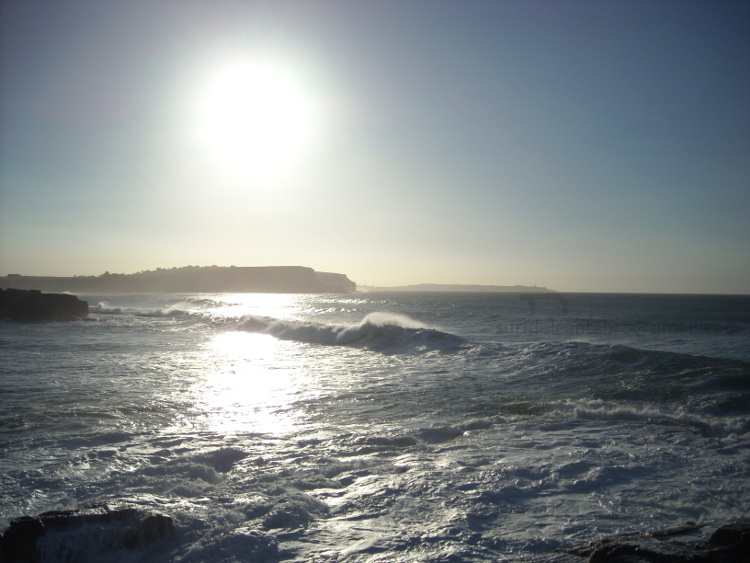
Icono Español-Inglés. Icon Spanish-English Fotogafías Playa de Galizano/Galizano beach. Photographs

Ola en Galizano
Ola en GalizanoIcono separador. Icon divider

Icon close Sponsor

Share

Galizano, localización

Icono Español. Icon Spanish La Playa de Galizano se encuentra en la localidad de Galizano, que pertenece al municipio de Ribamontán al Mar. Desde Galizano se accede a la siguientes playas: Playa de Arenilla y Playa de Galizano. La primera de ellas es una pequeña cala de difícil acceso y rodeada por acantilados sobre mar abierta. Apta para el baño con precaución, pues tiene fuertes corrientes y puede ser peligrosa, es ideal para el disfrute apartado de la naturaleza. La segunda playa es de mayor extensión y presenta un fuerte oleaje, característico de esta parte de la costa cántabra. Buenas olas y un entorno que exige cierto nivel en la práctica del surf. Se puede llegar hasta la Playa de Galizano desde Oviedo, Palencia, Santander o Bilbao. Comenzando el viaje por autovía y finalizando por carretera nacional. Una vez situados en Galizano el camino de la playa esta bien indicado.

Galizano Beach, Localization

Icono Inglés. Icon English Galizano beach is located in the town of Galizano, which belongs to the municipality of «Ribamontán al Mar«. Galizano gives access to the following beaches: «Arenilla» beach and Galizano beach. The first of these is a small cove of difficult access and surrounded by cliffs on open sea. Suitable for bathing with caution, because it has strong currents and can be dangerous, it is ideal for the enjoyment of nature. The second Beach is largest and presents a strong swell, characteristic of this part of the Cantabrian coast. Good waves and an environment that requires a certain level in the practice of surfing. You can reach the beach of Galizano from Oviedo, Palencia, Santander or Bilbao. Starting the journey by motorway and ending by national road. Once placed in Galizano the way of the beach is well signposted .

Icono Español-Inglés. Icon Spanish-English Localización/Localization

Oviedo, Galizano: LocalizationPalencia, Galizano: LocalizationBilbao, Galizano: LocalizationSantander, Galizano: Localization

Icon close Sponsor

Share

Galizano. Acceso

Icono Español. Icon Spanish La Playa de Galizano tiene un único acceso a través de la localidad de Galizano. Se puede llegar a ella desde Santander por: la autovía A8, la carretera nacional CA-146 y la rotonda que enlaza esta última con la CA-141. Desde Bilbao por: A8,CA-147 y CA-141. Una vez en la localidad es fácil llegar al parking desde el que se puede acceder a las playas. La Playa de Arenilla está situada a la izquierda, adyacente, de la Playa de Galizano.

Nota: Aconsejo utilizar este acceso directo desde Galizano. Por las peculiaridades de esta parte de la costa cántabra. Pues es abundante en pequeñas fincas y carreteras anexas. Se puede convertir en un laberinto si no se conoce.

Galizano. Access

Icono Inglés. Icon English Galizano Beach has a unique access through the town of Galizano. You can reach it from Santander by: highway A8, CA-146 national road and the roundabout that connects with the CA-141. From Bilbao: A8, CA-147 and CA-141. Once in the village is easy to come to the parking from which you can access the beaches. «Arenilla» beach is located to the left, adjacent to Galizano beach.

Note: You can access from another ways, but I would advise to use this shortcut from Galizano. Due to the peculiarities of this part of the Cantabrian coast that is abundant on small farms and adjacent roads. If you don´t know it previously this place can become a maze.

Icono Español-Inglés. Icon Spanish-English Acceso/Beach Access

Acceso:Galizano

Icon close Sponsor

Share

El Brusco, acceso. Naturaleza salvaje

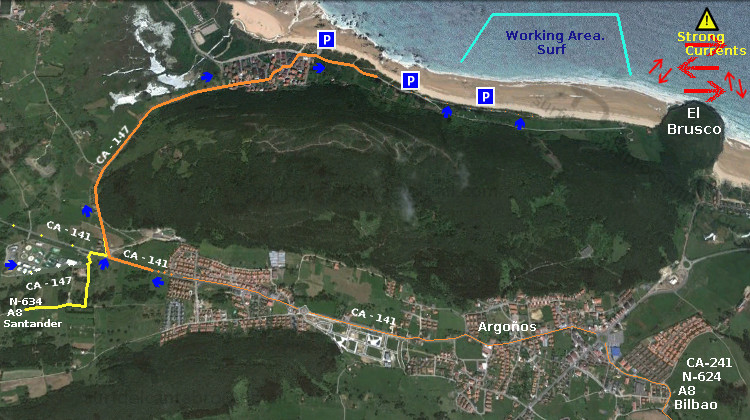
Icono Español. Icon Spanish. El Brusco, acceso El Brusco puede ser accedido desde el oeste por Santander. A través de la autovía A8, la carretera nacional N-634 y finalizando en el cruce entre las carreteras nacionales CA-141 y CA-147. Desde el este por Bilbao utilizando la autovía A8, las carreteras nacionales N-634 y CA-141 y finalizando en el cruce de esta última con la carretera nacional CA-147.

Nota: Si usted visita la villa de Noja, cruzando el Paseo de Tregandín llegará al Monte El Brusco y a su playa.

El Brusco, access. Wild Nature

Icono Inglés. Icon English. El Brusco, access «El Brusco» can be accessed from the west by Santander. Through the A8 motorway, the national road N-634 and ending at the crossroad between the national roads CA-141 and CA-147. From the east by Bilbao using the motorway A8, and the national road N-634 and CA-141 and ending at the junction of the latter with the national highway CA-147.

Note: If you visit the villa of Noja, crossing the Walk of Tregandín you will arrive to El Brusco Mountain and its beach.

Icono Español-Inglés. Icon Spanish-English Acceso/Beach Access

El Brusco, acceso/access

Icon close Sponsor

Share

El Brusco, localización

Icono Español. Icon Spanish «El Brusco» está situado al final de la playa de Trengandín, perteneciente al municipio de Noja. La segunda mitad de la playa; debido a que su acceso se realiza por el barrio de Helgueras, recibe el nombre de playa de Helgueras. Al final de la playa de Helgueras se encuentra el Monte el Brusco, de ahí que esta zona final de la playa se conozca con el mismo nombre: El Brusco. Se puede llegar al Brusco desde Oviedo, Palencia, Santander o desde Bilbao. Cualquier viaje con distinto origen comparte final de recorrido con el trayecto que se hace desde los puntos de partida anteriores. Comenzando por autovía y finalizando por carretera nacional.

El Brusco, Localization

Icono Inglés. Icon English «El Brusco» is located at the end of Tregandín beach, belonging to the municipality of Noja. The second half of the beach; due to its access is performed by the neighborhood of Helgueras, receives the name of Helgueras beach. At the end of the Helgueras beach is The Brusco mountain, so this area is known with the same name. You can reach «El Brusco» from Oviedo, Palencia, Santander or Bilbao. Any trip with another origin shares the end of travel with the journey that is made from the above starting points. Starting by motorway and ending by national road.

Icono Español-Inglés. Icon Spanish-English Localización/Localization

Oviedo, El Brusco: LocalizationPalencia, El Brusco: LocalizationBilbao, El Brusco: localizationSantander, EL Brusco: Localization

Icon close Sponsor

Share

Ola Gigante. Desde El Brusco hacia Berria.

Icono Español. Icon Spanish La segunda mitad de la playa de Tregandín, en la localidad de Noja, coincide con el barrio de Helgueras y esta parte de la playa se conoce con el nombre de Helgueras. Noja y Santoña a nivel de sus playas están separadas por el monte El Brusco. Se puede pasar desde la playa de Helgueras hasta la playa de Berria o viceversa utilizando el sendero que atraviesa el monte hasta su cima de 237 metros y desciende al otro lado. Las vistas que se divisan en invierno en la playa de Berria forma un retrato que desvela la naturaleza de la costa y el Mar Cantábrico. A este paraje se le añade otro de igual belleza, el que se divisa desde la playa de Helgueras. Ambas zonas ofrecen unas condiciones perfectas y particulares para la práctica del surf.

En El Brusco se obtiene una composición de estas dos zonas y se divisa el marco total que las envuelve. Desde la cima se ven llegar las olas hasta la playa, a ambos lados; naciendo a 100 metros de la orilla y alcanzando los 2 metros de altura, con regularidad. Alzando la vista hacia el mar abierto, prestando atención, se ven olas formarse a lo lejos. Olas que si el ojo percibe en la distancia hace pensar en las dimensiones reales de estas. El viernes pasado disfrute de ese espectáculo en varias ocasiones. Divise olas a un kilómetro de distancia de la playa, las vi crecer, recorrer unos 200 metros de y desvanecerse lejos aún de la orilla. Fue un espectáculo estimulante y calmante. Ya situado a los pies de El Brusco, antes de partir de regreso, gire la cabeza hacia el mar para disfrutar la última mirada. Lo que vi me emociono y sorprendió. Allí estaba, no paraba quieta, parecía moverse lentamente. Me dio tiempo a hacer 4 fotografías y ver como se dirigía hacia la playa de Berria. Era una ola gigante.

He realizado cálculos de perspectiva sobre la imagen que publico a continuación. Teniendo en cuenta: la distancia a la costa; aproximadamente 500 metros en el momento de tomar la foto, el tiempo que pude contemplar la ola,el angulo de mi camara, … . He llegado a pensar que tengo un error en los cálculos de 5 metros, pues el valor obtenido me parece exagerado. Fotografía de una ola de más de 10 metros, en El Brusco; Cantabria, a 17 de Enero de 2014.

Giant Wave. From El Brusco to Berria

Icono Inglés. Icon English The second half of the beach of Tregandín, in the town of Noja, coincides with the neighborhood of Helgueras and this part of the beach is known by the name of Helgueras. Noja and Santona at the level of its beaches are separated by the mount El Brusco. You can go from Helgueras beach to Berria beach or vice versa using the footpath that crosses to the top of 237 meters of El Brusco and descends to the other side. The views seen in the winter at the beach of Berria form a portrait that reveals the nature of the coast and the Cantabrian Sea. Add to this place another of equal beauty, which can be seen from Helgueras beach. Both areas offer perfect and special conditions for the practice of surfing.

EL Brusco gets a composition of these two areas and you can see the total frame that surrounds them. From the top it is seen to come the waves up to the beach, on both sides; being born to 100 meters of the shore and reaching 2 meters high, regularly. Raising the view toward the open sea, paying attention, you can see the waves that are created in the distance. Waves that if the eye sees in the distance makes you think in the real dimensions of them. Last Friday I enjoyed this show many times. I divise waves far away from the beach (1 km), saw them born, walking 200 metres and then fade away . It was a spectacle stimulating and soothing. I already located at the foot of the mount, before departing, I turned toward the sea to enjoy the last look. What I saw made me feel emotion and surprise. There it was, it was not stopping , it seemed to move slowly. I had time to do 4 photos and to see as it was going towards the Berria beach. It was a giant wave.

I have done perspective calculations on the image that I publish next. Bearing in mind: the distance to the coast; approximately 500 meters at the moment of taking the picture, the time that I could contemplate the wave, the angle of my camera … . I have come to believe that I have an error in the calculations of 5 meters, because the value obtained seem to me exaggerated. Photograph of a wave of more than 10 meters, in El Brusco; Cantabria, 17 January 2014.

Separador. DividerIcono Español-Inglés. Icon Spanish-English
Ola Gigante, El BruscoIcono separador. Icon divider

Icon close Sponsor

Share