Tagle, playa

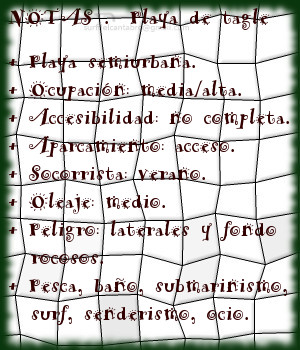
Icono Español. Icon Spanish. Tagle, playa La playa de Tagle, llamada Playa El Sable, se encuentra en la localidad de Tagle, perteneciente al municipio de Suances, en la costa occidental de Cantabria. El arenal de 200 metros de longitud y 50 metros de ancho, está precedido por un gran aparcamiento que es ocupado totalmente en la estación estival.

La llegada a la playa de Tagle encuentra una cuesta con una pendiente suave, cada paso del caminante se ve ayudado por la inclinación. Poco a poco la zona aumenta su anchura para ir descubriendo la playa, sus laterales, las rocas dispersas dentro de sus aguas. El sonido del Mar Cantábrico, chocando con la Playa EL Sable, entona una melodía que expresa el carácter de la unión entre ambos. Música suave y atrayente ó violenta y natural, ambos estados registra la playa de Tagle.

Los laterales y fondo rocoso la convierten en una playa peligrosa para la práctica del surf. La zona hábil para navegar se encuentra alejada de la línea de costa, evitando las zonas rocosas y situada fuera de la ensenada que forma la playa con el entorno. Las rocas que restan en la zona constituyen la base de la prehistórica y ancestral costa. El efecto de la fuerza del oleaje y las grandes mareas han ido erosionando y afilando los acantilados que son los vestigios que ahora quedan, a modo de entorno rocoso.
Cabecera Cities Place Beaches. Tagle, playa
Tagle, notas

Tagle, beach

Icono Inglés. Icon English. Tagle, beach Tagle’s beach, also called Beach El Sable, is in the locality of Tagle, belonging to the municipality of Suances, on the western coast of Cantabria. The sandbank of 200 meters of length and 50 meters of width, is preceded by a great parking which is totally occupied on the summer station.

The arrival to Tagle’s beach finds a slope with a soft slope, every step of the wayfarer meets helped by the inclination. Little by little the zone increases its width to discover the beach, its wings, the dispersed rocks inside its waters. The sound of the Cantabrian Sea, shocking the Beach El Sable, intones a melody that expresses the character of the union between them. Soft and attractive music or violent and natural, both conditions are register in Tagle’s beach.

The wings and bottom turn her into a dangerous beach for the practice of the surf. The skilful zone to sail is removed from the coast line, avoiding the rocky areas and placed out of the inlet that forms the beach with the environment. The rocks that remain in the zone constitute the base of the prehistoric and ancient coast. The effect of the force of the surge and the big tides have been eroding and sharpening the cliffs that are the vestiges that now stay, like rocky environment.
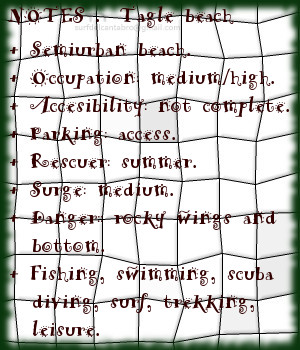
Cabecera Cities Place Beaches. Tagle, beach
Tagle, notes

Share

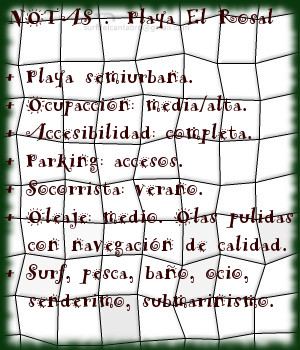
El Rosal, playa

Icono Español. Icon Spanish. El Rosal, playa La playa El Rosal, también conocida como Tostadero, está situada en el municipio de San Vicente de la Barquera, en la costa occidental de Cantabria. Delimitada en su lado izquierdo por un espigón que separa el arenal de la Ría de San Vicente de la Barquera. Su longitud de 360 metros y anchura media de 60 metros disponen una pequeña área parcialmente protegida del oleaje.

Cuenta, su espigón, con un pequeño faro en el extremo final. Este punto, situado a 150 metros de la orilla, es conocido como el Farolillo. La zona dispone de otro malecón natural, el Islote de Peña Menor, que cubre totalmente al primero. Estas barreras naturales que preservan a la zona del Mar Cantábrico y filtran el oleaje que hasta allí llega, junto con las características del entorno ayudan a producir unas ondas especiales que abren sus alas a lo ancho para llegar posteriormente hasta el arenal.

Cuando las series de olas salvan los espigones, nace una ola que abre a ambos lados. De pendiente suave y prolongada, aparecen recorridos medios a derechas. Sí las condiciones son favorables la apertura izquierda de la onda puede alcanzar un trayecto mayor. La superficie pulida del agua, el rizamiento de la ola y el desplazamiento prolongado de las elevaciones que transportan las ondas consiguen crear olas cuyos parámetros son sólo valores que, en conjunto y después de surfear, hablan de la naturaleza del Cantábrico en esta parte de Cantabria.

Cabecera Cities Place Beaches. El Rosal, playa
El Rosal, notas

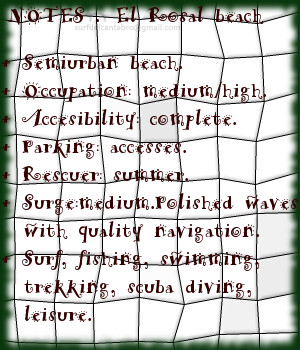
El Rosal, playa

Icono Inglés. Icon English. El Rosal, beach The beach El Rosal, also known as Tostadero, is placed in the municipality of San Vicente de la Barquera, in the western coast of Cantabria. Delimited in its left side for a breakwater that separates the sandbank of the Stuary of San Vicente de la Barquera. Its length of 360 meters and average width of 60 meters arrange an small area partially protected from the surge.

It counts,its dyke,with an small beacon in the final end. This point placed to 150 meters of the shore, is known as el farolillo. The zone has another natural levee, Peña Menor Islet, which covers totally to the first one. These natural barriers that preserve to the zone of the Cantabrian Sea and leak the surge that comes up to there, together with the characteristics of the environment help to produce a few special waves that open its wings widthways; and will arrive later up to the sandbank.

When the series of waves overcomes the levees, there is born a wave that opens to both sides. Of soft and long slope, a medium distance tours that open to the right appear. If the conditions are favorable the left opening of the wave can reach a major distance. The polished surface of the water, the curling of the wave and the long displacement of the elevations that transport the waves manage to create waves which parameters are only values that as a whole and after surfing speak about the nature of the Cantabrian Sea in this part of Cantabria.

Cabecera Cities Place Beaches. El Rosal, beach
El Rosal, notes

Share

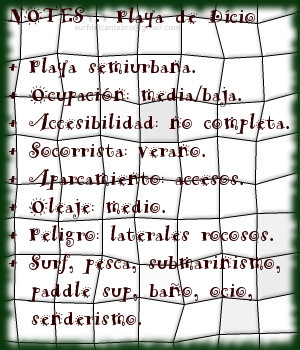
Dício. Mioño, playa

Icono Español. Icon Spanish. Dício Mioño playa La playa de Dício está ubicada en la localidad de Mioño, perteneciente al municipio de Castro Urdiales, en la costa oriental de Cantabria. Su longitud de 350 metros y 40 metros de anchura media, abren la escarpada y condensada costa de Mioño al Mar Cantábrico.

El entorno rocoso que contiene a la playa se extiende desde la Punta de Saltacaballos hasta la Punta de Mioño; próxima a Castro Urdiales. Albergando varias calas en su recorrido, es Dício la más grande de todas ellas. La desembocadura del Río Mioño da forma al litoral creando un recodo entre el arenal y la costa, parcialmente protegido por un pequeño espigón que tiene 40 metros de longitud. La carretera que da acceso a la playa se prolonga a través de un camino peatonal que llega hasta un antiguo cargadero de mineral. Este trayecto constituye un singular paseo marítimo que posibilita el descubrimiento de una parte del Mar Cantábrico nunca antes imaginada.

Las dimensiones de la playa reducen el recorrido de las ondas. Abriendo a ambos lados, favorecen las maniobras y exigen un alto nivel de surf. El oleaje en Dício registra un tamaño menor que en las playas colindantes, representando una opción cuando el estado de la mar es fuerte. Sin embargo, las características de la playa, la abundante presencia de rocas y el estado del mar en esos días, la hacen sólo apta para profesionales y surfers experimentados conscientes de los riesgos.

Las jornadas con menor tamaño descubren una zona con abundantes olas, ideales para practicar: maniobras, paddle sup… disfrutando del entorno sencillo y único de Mioño.

Cabecera Cities Place Beaches. Dício Mioño playa
Dicio Mioño playa. notas

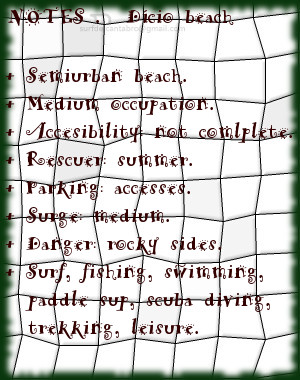
Dício. Mioño, playa

Icono Inglés. Icon English. Dício, Mioño, beachThe beach of Dício is located in the locality of Mioño, belonging to the municipality of Castro Urdiales, on the oriental coast of Cantabria. Its length of 350 meters and 40 meters of average width opens the steep and condensed coast of Mioño to the Cantabrian Sea.

The rocky environment that it contains to the beach spreads from Saltacaballos’s Tip up to Mioño’s Tip; next to Castro Urdiales. Sheltering several coves in its tour, it is Dício the biggest of them. The river mouth of the River Mioño gives form to the littoral creating a bend between the sandbank and the coast, partially protected by an small pier that has 40 meters of length. The road that leads to the beach extends across a pedestrian way that comes up to a former loading/unloading platform of mineral. This distance constitutes a singular and natural promenade that makes possible the discovery of a part of the Cantabrian Sea never before imagined.

The dimensions of the beach reduce the length of the waves. Opening to both sides, them favor the maneuvers and demand a high level of surf. The surge in Dício registers a minor size that in the adjacent beaches, representing an option when the condition of the sea is strong. Nevertheless, the characteristics of the beach, the abundant presence of rocks and the condition of the sea in these days, make it only suitable for professionals and surfers experienced conscious of the risks.

The days with minor size discover a zone with abundant waves, ideal to practise maneuvers, paddle sup … enjoying the Mioño’s simple and unique environment.

Cabecera Cities Place Beaches. Dício Mioño beach
Dicio Mioño beach, notes

Share

Brazomar, playa

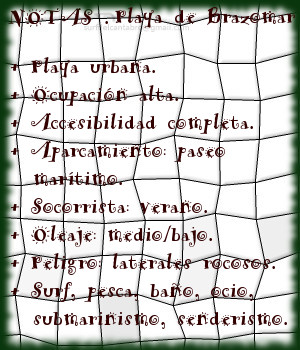
Icono Español. Icon Spanish. Brazomar, playa La playa de Brazomar está ubicada en la ciudad de Castro Urdiales, en la costa oriental de Cantabria. Esta playa situada dentro de la ciudad, de 400 metros de longitud y 40 metros de anchura media, disfruta de todos los servicios; destacando su paseo marítimo que se prolonga a través de la localidad.

El muelle de Don Luis, acota la playa en su ala izquierda, recibe el oleaje del Mar Cantábrico que se agolpa sobre el muro para cambiar la dirección de las olas y alcanzar el resto de la ensenada. Ambos laterales del arenal tienen fondo rocoso, parcialmente visible con la bajamar. Sus olas de tamaño medio abren a ambos lados, siendo hábiles cerca de la orilla. El pequeño recorrido que alcanzan las ondas, entre 50 metros y 150 metros, favorece las maniobras.

La dirección del oleaje determina el comportamiento de las olas que llegan a Brazomar. Puede arribar casi recto hasta la ensenada o proveniente del este u oeste; para proyectar las olas al lado opuesto de la playa. Comienzan las masas de agua a formar pequeñas colinas que entuban con rápidez. La pared de agua que abre el rizo es fragmentada, por el fondo rocoso, exigiendo concentración y destreza en su navegación. Cuando la Mar lo propicia, las olas hábiles se alejan considerablemente de la orilla, situando la línea de surf en los laterales y disponiendo de un recorrido considerablemente mayor, ofreciendo a surfistas y caminantes su mejor espectáculo.

Cabecera Cities Place Beaches. Brazomar, playa
Playa de Brazomar. Notas

Brazomar, beach

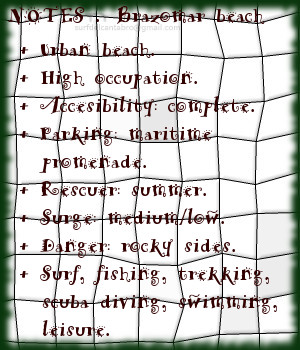
Icono Inglés. Icon English. Brazomar, beach The beach of Brazomar is in the city of Castro Urdiales, in the oriental coast of Cantabria. This beach is placed inside the city, with 400 meters of length and 40 meters of average aproximately width, enjoys all the services; emphasizing its maritime walk that extends across the city.

The Wharf of Don Luis, it annotates the beach in its left wing, receives the surge of the Cantabrian Sea that accumulates on the wall to change the direction of the waves and to reach the rest of the inlet. Both wings of the sandbank have rocky bottom, which are partially visible with the low tide. Its medium size waves open to both sides, being suitable near the shore. The small tour that the waves reach, between 50 meters and 150 meters, favors the maneuvers.

The surge direction determines the behavior of the waves that come to Brazomar. It can arrive almost straightly up to the inlet or from: East or West; to project the waves to the opposite side of the beach. Them begin, the water masses, to form small hills that curl quickly. The water wall that opens the curl is fragmented, by the rocky bottom, demanding concentration and skill in its navigation. When the Sea propitiates the best conditions to navigate, the skilful waves move away considerably from the shore, placing the line of surf in the wings and having a considerably major tour, offering to surfers and wayfarers its better spectacle.

Cabecera Cities Place Beaches. Brazomar beach
Brazomar beach. Notes

Share

Playa de Arenillas. Islares

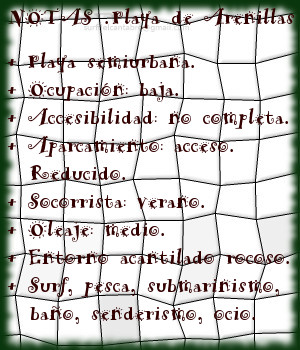
Icono Español. Icon Spanish. Playa de Arenillas, Islares La Playa de Arenillas está situada en la localidad de Islares, perteneciente al municipio de Castro Urdiales, en la costa oriental de Cantabria. Es una pequeña cala de 50 metros de longitud y anchura media aproximada de 15 metros que prácticamente queda cubierta con la marea alta.

Sus tranquilas aguas bañan el lado izquierdo de la Ensenada de Oriñón. El agua cristalina y su contorno rocoso hacen de la Playa de Arenillas una zona ideal para practicar submarinismo, cuando las condiciones del oleaje lo permiten. Recogida entre formaciones rocosas y protegida parcialmente, recibe las olas que llegan a la playa de Oriñón. El oleaje, ligeramente suavizado; respecto de la playa grande, mantiene una cadencia optima. Olas de menor tamaño, equilibradas y pulidas llegan a su orilla. Las ondas en Islares están condicionadas por Isla Cercada, que rompe las grandes masas de agua que entran a la ensenada, para reconstruir una forma reducida posteriormente. Con su fuerza limitada y pequeño recorrido favorecen las maniobras. Abren su avance hacia la derecha, teniendo los acantilados en frente, disponiendo la navegación a ambos lados. El lado derecho de la onda se extiende en dirección hacia Oriñón, acotado por la desembocadura del Río Agüera, interrumpe su recorrido a la entrada del arenal grande.

Localizada a los pies del macizo Cerredo, al cobijo de la curva rocosa que la contiene, se dispone la Playa de Arenillas. Un pequeño aparcamiento campestre hace de antesala a la pequeña cala que ofrece y regala ella sus aguas, sus olas, la vista panorámica del entorno espectacular y único en Cantabria. Caminantes y surfistas; al encuentro de la belleza que en ella comienza.

Cabecera Cities Place Beaches. Playa de Arenillas. Islares
Playa de Arenillas, Islares. Notas

Arenillas beach. Islares

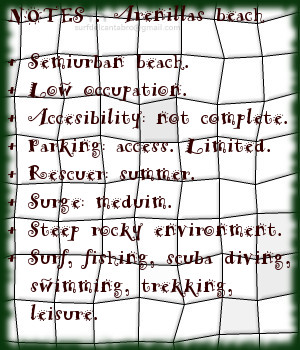
Icono Inglés. Icon English. Arenillas beach. Islares The Beach of Arenillas is placed in the locality of Islares, belonging to the municiplaity of Castro Urdiales, in the oriental coast of Cantabria. It is a small cove with 50 meters of length and average approximate width of 15 meters that practically remains covered with the high tide.

Its calm waters surround the left side of Oriñón’s Inlet. The crystalline water and its rocky contour do of the Beach of Arenillas an ideal zone to practise scuba diving, when the conditions of the surge allow it. Gathered between rocky formations and partially protected, it receives the waves that come to Oriñón’s beach. The surge, lightly smoothed; in relation to the big beach, it endures an ideal cadence. Waves of minor size, balanced and polished come to its shore. The waves in Islares are determined by Cercada Island, which breaks the big masses of water that enter to the inlet, to reconstruct a limited form later. With its limited force and small tour, them are suitable for the maneuvers. Them head its advance for the right, having the cliffs in front of them and opening the navigation to both sides. The right side of the wave spreads in direction towards Oriñón, annotated by the Agüera river mouth, interrupts its tour at the entrance of the big sandbank.

Located to the feet of the massif Cerredo, in the cover up of the rocky curve that contains it, arranges the Beach of Arenillas. An small rural parking does of anteroom to the small cove that offers and gives its waters, its waves, the panoramic sight of the spectacular and unique environment in Cantabria. Wayfarers and surfers; to the meeting of the beauty that in it begins.

Cabecera Cities Place Beaches. Arenillas beach. Islares
Arenillas beach, Islares. Notes

Share

Oriñón, playa

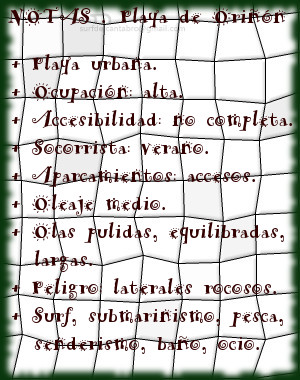
Icono Español. Icon Spanish. Oriñón playa La playa de Oriñón está situada en el pueblo costero de Oriñón, perteneciente al municipio de Castro Urdiales, en la costa oriental de Cantabria. Sus dimensiones, un kilómetro de largo y anchura media aproximada de 100 metros, son uno de los atributos que forman parte de la playa. Situando el arenal sobre el plano, el resto de características va dimensionando y definiendo una singular y espectacular zona. Pues es la Ensenada de Oriñón un área de alto nivel para deportes acuáticos y el entretenimiento.

La separación entre los macizos de Cerredo y Candina forman la Ensenada de Oriñón que contiene a la playa. Proporcionan estos montes protección al arenal actuando como un filtro natural eólico. La Ría de Oriñón, situada en la desembocadura del Río Agüera, acota a la playa en su principio, y provoca que la diferencia entre las mareas altas y bajas hagan aparecer 500 metros de playa. En frente de Oriñón, el Mar Cantábrico. Salpicado de islotes y con la península La Punta de Sonabia, conocida como la Ballena, actuando de medio cierre. Esta configuración hace barrera y transforma el oleaje que llega a la ensenada.

Las olas que arriban a la playa de Oriñón son principalmente de izquierdas. La amplitud del banco de arena permite varios picos de olas, que en la zona central abren a ambos lados. La superficie pulida de las olas, su equilibrada pendiente y la longitud que pueden alcanzar éstas, hacen de la navegación una experiencia donde el mar penetra a través de los sentidos y la vista disfruta del entorno que recorre.

Cabecera Cities Place Beaches. Oriñón playa
Oriñón playa. Notas

Oriñón, beach

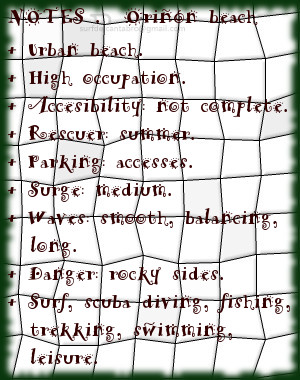
Icono Inglés. Icon English. Oriñón, beach The beach of Oriñón is placed in the coastal village of Oriñón, belonging to the municipality of Castro Urdiales, in the oriental coast of Cantabria. Its dimensions, a kilometre of length and average approximate width of 100 meters, are one of the attributes that form a part of the beach. Placing the sandbank on the plane, the rest of characteristics measure and define a singular and spectacular zone. So it is the Inlet of Oriñón a high-level area for aquatic sports and the entertaiment.

The separation between the massifs of Cerredo and Candina form the Inlet of Oriñón that it contains the beach. These mounts provide protection to the sandbank acting as a natural wind filter. The Stuary of Oriñón, placed in the Agüera river mouth, encloses the beach in its beginning, and provokes the difference between the high and low tides that make appear 500 meters of beach. In front of Oriñón, the Cantabrian Sea. Splashed with islands and with the peninsula Tip of Sobania, known as the Whale, acting of half a closing. This configuration does barrier and transforms the surge that comes to the inlet.

The waves that arrive at Oriñón’s beach are principally of left sides. The extent of the sandbank is home to several beaks of waves, which in the central zone open to both sides. The polished surface of the waves, its balanced slope and the length that these can reach; it do of the navigation an experience where the Sea penetrates across the senses and the sight enjoys the environment that crosses.

Cabecera Cities Place Beaches. Oriñón, beach
Oriñó beach, Notes

Share

La Salvé, playa

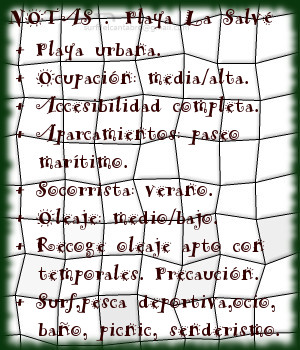
Icono Español. Icon Spanish. La Salve, playa La playa de La Salvé se encuentra en el municipio de Laredo, ubicado en la costa oriental de Cantabria. Es un extenso arenal de más de cuatro kilómetros de longitud y anchura media aproximada de 140 metros. Jalonada por un paseo marítimo a lo largo de su recorrido que la presenta y permite al caminante disponer de una posición privilegiada para su contemplación.

Empezando el paseo en el extremo derecho, próximo al puerto deportivo, avanzan los pasos a través de la media luna que dibuja este allí. Caminando, podemos disfrutar de la villa a mano izquierda y del Mar a mano derecha. Varias entradas al arenal aparecen al encuentro para, una vez atraídos, acceder a la playa. Pasado el pequeño sistema dunar cercano al paseo, asoma un llanura que se extiende por debajo de sus aguas, pues La Salvé recuerda a una playa de otros mares. Para alcanzar profundidad, debemos recorrer una extensión mayor que en el resto de playas cántabras.

Debido a las características de la playa, la presencia de olas no es regular. Los tamaños medios ó bajos de las ondas se ven incrementados cuando arrecia temporal, abriendo numerosos picos de olas a lo largo de La Salvé, que se suceden a izquierdas y derechas. Su configuración y parámetros, la convierten en una zona ideal para practicar sky-surf y paddle-surf, wind-surf. El otoño e invierno traen a Laredo los mejores momentos de surf, que ayudados con la gran extensión y fisionomía de la zona, ofrecen a los surfistas un circuito con variedad cuantitativa y cualitativa.

Cabecera Cities Place Beaches. La Salve, playa
La Salve, Notas

The Salvé, beach

Icono Inglés. Icon English. The Salvé, beach The beach of The Salvé is in the municipality of Laredo, located in the oriental coast of Cantabria. It is an extensive sandbank with more than four kilometres of length and average approximate width of 140 meters. Marked by a maritime walk along its tour that presents it and allows to the wayfarer to have a position favoured for the contemplation.

Beginning the walk in the right wing, next the sports port, the steps advance across the half moon that draws this one, there. Walking, we can enjoy the villa to the left hand and the Sea to the right hand. Several points to income to the sandbank appear to the meeting for; once attracted, accede to the beach. Then the small dune system near the promenade, it puts out a llanura that spreads below his waters, because The Salvé resembles a beach of other seas. To reach depth, we must cross a major extension than the rest of Cantabrian beaches.

Due to the characteristics of the beach, the presence of waves is not regular. The average sizes or low of the waves are increased when storms arrive, opening numerous beaks of waves along The Salvé, that open to the left and right sides. Its configuration and parameters, turn it into an ideal zone to practise sky-surf, paddle-surf and windsurfing. The autumn and winter bring to Laredo the best moments of surf, which helped with the great extension and physiognomy of the zone, offer a circuit to the surfers with quantitative and qualitative variety.

Cabecera Cities Place Beaches. The Salve, beach
La Salve, Notes

Share

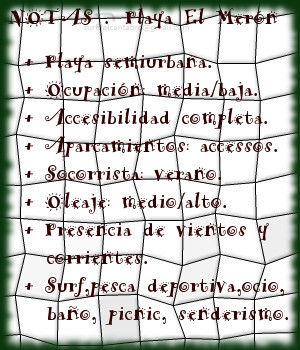
El Merón, playa

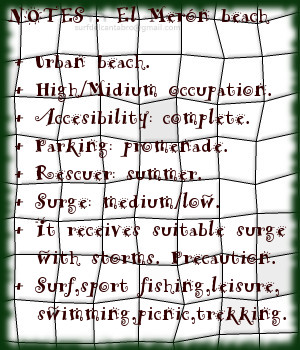
Icono Español. Icon Spanish. El Meron playa La playa El Merón está situada en San Vicente de la Barquera, municipio emplazado en la costa occidental de Cantabria. Su longitud de 2,5 kilómetros y anchura media aproximada de 60 metros, la convierten en una de las playas más extensas de Cantabria. La marea baja descubre una llanura de arena fina y compacta, sobre la que se forman y desarrollan distintos tipos de olas que el Mar Cantábrico transporta y entrega.

Delimitada en su extremo izquierdo por el espigón que separa la Ría de San Vicente de la Barquera del arenal, aparece un extenso área acotada y protegida parcialmente de la fuerza del Mar. Dibuja la costa en este punto una ligera curva que propicia variedad de olas, en cuanto a forma y extensión. Abriendo las ondas a ambos lados, destacan sus izquierdas. Alargadas y con su pared de agua sostenida, van trasladando la parte navegable de la ola hasta el final del trayecto curvado.

Continua la playa en línea recta hasta su otro extremo, al encuentro con la playa de Gerra. Es esta una zona de gran amplitud, con abundantes picos de olas que abren a ambos lados. Disponen sus ondas de varios niveles de profundidad, a diferentes distancias de la orilla. No siendo esta regla regular, cuando se cumple ofrece un variado repertorio de opciones para todos los niveles e intensidades. Destaca la naturaleza del Mar en esta parte de la costa Cántabra. La llegada de las series de olas sobre volúmenes de agua que proporcionan una suave pendiente libre y limpia para la navegación. Acuden ellas al encuentro con la fina arena sin demora, ni prisa, trasluciendo a través de su velocidad óptima una parte de su alma.

La potencia progresiva y rítmica de las aguas del Merón, produce un discurso familiar por conocido, que el recuerdo; una vez de vuelta, distinguirá como singular y único.

Cabecera Cities Place Beaches. El Meron playa
El Meron playa. Notas

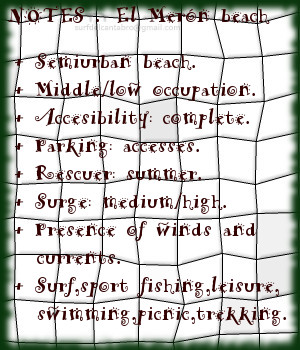
The Merón, beach

Icono Inglés. Icon English. El Merón, beach The beach The Merón is placed in San Vicente de la Barquera, municipality located in the western coast of Cantabria. Its length of 2,5 kilometres and average approximate width of 60 meters, turn it into one of the most extensive beaches of Cantabria. The low tide discovers a plain of thin and compact sand, over it are formed and develop different types of waves, that are transported and delivered by the Cantabrian Sea.

Delimited in its left wing by the breakwater that separates the Stuary of San Vicente de la Barquera of the sandbank, appears an extensively and protected area which is partially shield against the force of the Sea. The coast draws, in this point, a light curve that propitiates variety of waves, in its form and extension. The waves open for both sides, stand out its left sides. Lengthened and with its supported wall of water, them move its navigable part to the end of the curved route.

It continues the beach on straight line up to its other end, to the meeting with Gerra’s beach. It is this zone of great extent, with abundant beaks of waves that open to both sides. It arrange its waves in several levels of depth, to different distances of the shore. Not being this regular rule, when it is fulfilled; it offers a varied digest of options for all the levels and intensities. The nature of the Sea stands out in this part of the Cantabrian coast. The arrival of the series of waves in water volumes which provide a soft, free and clean slope for the navigation. Them come to the encounter with the thin sand, without delay, or hurry, revealing across its ideal speed; a part of its soul.

The progressive and rhythmic power of the Merón’s waters, produces a familiar speech as known before, that the recollection; once of return, will distinguish like singular and unique.

Cabecera Cities Place Beaches. El Merón beach
El Merón beach . Notes

Share

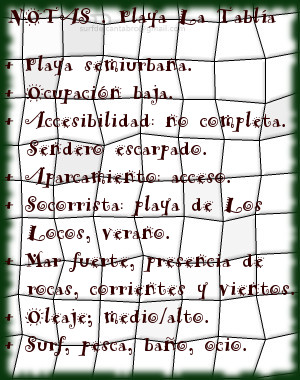
La Tablía, playa

Icono Español. Icon Spanish. La Tablía, playa La playa La Tablía, también llamada El Huerto, se encuentra en el municipio de Suances, en el extremo oeste de la costa central de Cantabria. Esta pequeña playa, de 80 metros de longitud y una anchura media de apenas 10 metros, es cubierta prácticamente en su totalidad con la marea alta. Separada de la Playa de Los Locos por la Punta de Sopico, disfruta de la misma calidad de olas que su playa hermana mayor y más conocida, con algunas variaciones y características propias.

Descansando en la base de los acantilados que delimitan la costa de Suances, este punto con forma curvada, pendiente practicable y cubierta de vegetación, dispone de un sendero que da acceso a la cala. Tras el descenso, las abundantes rocas del pequeño arenal hacen indicar que el punto adecuado para practicar surf se encuentra a 150 metros de la orilla, aproximadamente. La presencia de rocas en el área, la cercanía del acantilado y la fuerza del mar aconsejan extremar las precauciones. Evitar la cercanía de la costa en la parte final de la navegación es recomendable. La ola de La Tablía abre a derechas y dispone un viaje largo. Su recorrido favorece el contacto con la pared de la ola, las maniobras para continuar el trayecto. El viento, la energía del Mar Cantábrico, y la morfología del fondo marino que existen en la zona moldean la potencia y forma de las olas.

Llegar a La Tablía, desde el mirador que eternamente la divisa; ver el estado de la mar, para decidir entrar y, en ese caso, cambiar la perspectiva a través de la estancia en sus aguas, en sus olas. En cada trayecto la contemplación del ondulante movimiento de la superficie de sus aguas, que quizás; darán paso al nacimiento de una nueva ola.

Cabecera Cities Place Beaches. La tablía, playa
La Tablia, Notas

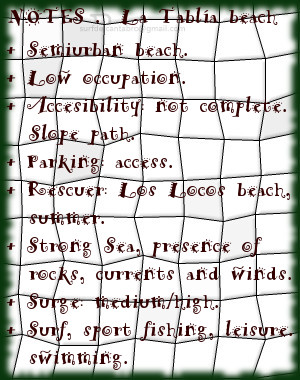
Isla, beach

Icono Inglés. Icon English. La Tablía, beach The beach of La Tablía, also called El Huerto, is in the municipality of Suances, in the extreme west of the central coast of Cantabria. This small beach, it has 80 meters of length and an average width of 10 meters, is covered practically in its entirety with the high tide. Separated from the Beach of Los Locos by Sopico Tip, it enjoys the same quality of waves than its relates major and more known beach, with some variations and own characteristics.

Resting in the base of the cliffs that delimit Suances’s coast, this point with curved form, practicable slope and covered with vegetation; has a path that leads to the cove. After the descent, the abundant rocks of the small sandbank indicate that the suitable point to practise surf is to 150 meters of the shore, approximately. The rocks presence in the area, the nearness of the cliff and the force of the sea, advise to carry to extremes the precautions. To avoid the nearness of the coast in the final part of the navigation is advisable. The wave of La Tablía opens to right and arranges a long trip. Its tour favors the contact with the wall of the wave, the maneuvers to continue the journey. The wind, the energy of the Cantabrian Sea, and the morphology of the sea bed that exist in the zone; mould the power and form of the waves.

Arrive at La Tablía, from the viewing-point that eternally has fun with it; to see the condition of the Sea, to decide to enter and, in this case, to change the perspective across the stay into its waters, into its waves. In every journey, the contemplation of the undulating movement of the surface of its waters, that probably; will give step to the birth of a new wave.

Cabecera Cities Place Beaches. La Tablía, beach
La Tablia, Notes

Share

Robayera, playa

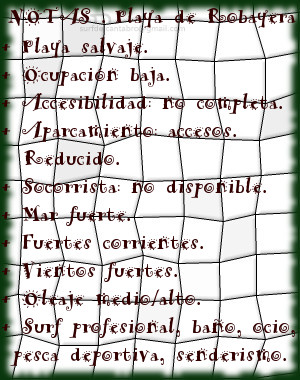
Icono Español. Icon Spanish. Rpbayera, playa La playa de Robayera se encuentra en el municipio de Miengo, en la costa central de Cantabria. Es un pequeño arenal de 100 metros de longuitud y una anchura media aproximada de 10 metros. Emplazada en la desembocadura de la Ría de Mogro, está expuesta a las fuertes corrientes que transitan del estuario hacia mar abierto y viceversa por efecto de las mareas, la morfología de la zona y la fuerza del Mar.

Esta pequeña, abrupta y rocosa cala es disfrutada en plenitud cuando recibe la marea baja. Ubicada en la ladera Este que une la Punta del Cuerno con la desembocadura de la ría, es un punto de confluencia de las corrientes y vientos de la zona. Su oleaje alto y potente es sólo apto para surfers profesionales que sean conscientes de los riesgos e impracticable cuando hay marejada.

Es por sus condiciones una zona ideal para la pesca deportiva y el senderismo. Comenzando el recorrido en la playa de Robayera, caminando sobre los acantilados, llegaremos a la Punta del Cuerno. El sonido del mar bañando la costa, acompañará cada paso sazonando el trayecto que se endulza con la contemplación del entorno. A la derecha un extenso arenal de más de 2 kilómetros de longitud, en frente un pequeño archipiélago compuesto por cuatro islotes. Desde su punto más al norte podremos divisar Suances y su entorno.

Cabecera Cities Place Beaches. Robayera, playa
Robayera beach, Notas

Robayera, beach

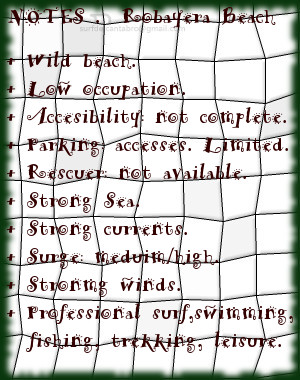
Icono Inglés. Icon English. Robayera, beach The beach of Robayera is in the municipality of Miengo, on the central coast of Cantabria. It is a small sandbank of 100 meters of length and an average approximate width of 10 meters. Located in the Stuary of Mogro, it is exposed to strong currents that move from the estuary towards open sea and vice versa due to effect of the tides, the morphology of the zone and the force of the Sea.

This small, abrupt and rocky cove is enjoyed in fullness when it receives the low tide. Located in the East hillside that joins El Cuerno Tip with the rivermouth , it is a point of confluence of the currents and winds of the zone. Its high and powerful surge is only suitable for professionals surfers who are conscious of the risks and impracticable when there is heavy sea.

It is for its conditions an ideal zone for sport fishing and the hiking. Beginning the tour in Robayera’s beach, walking on the cliffs, we will come to the El cuerno Tip. The sound of the sea lighting the coast, will accompany every step; which seasons the journey that is sweetened by the contemplation of the environment. To the right: an extensive sandbank of more than 2 kilometres of length, in front of us: an small archipelago composed by four islands. From its northern point, we will be able to enjoy Suances and its surroundings.

Cabecera Cities Place Beaches. Robayera, beach
Robayera beach, Notes

Share